Monday, October 12, 2015

Amending the Geneva Conventions to account for the technology age

A post on The Register asks: Cyberwar rules of engagement: Military, law bods mull update.  Is 'wartime metadata collection' a human rights violation?

Plans are underway to update a putative Geneva convention for cyberwar, put together by experts in international law and backed by an Estonian-based NATO-run military think tank.

The Tallinn Manual 2.0 is on track for publication in the second half of 2016, following a drafting conference of legal experts in the Estonian capital this week. The original manual provided a handbook on how principles of international law could be applied to conflict in cyberspace, which military strategists consider to be the fifth dimension of warfare (land, air, sea and space being the other four).

The original Tallinn Manual on the International Law Applicable to Cyber Warfare ruled that the Stuxnet worm may have been "armed attack", as previously reported. Victims of similar future attacks would be legally clear to retaliate proportionately in the immediate aftermath of an assault as an act of self-defence, in order to frustrate follow-up assaults.

Sunday, October 11, 2015

We're not Bolivia, for God's sake

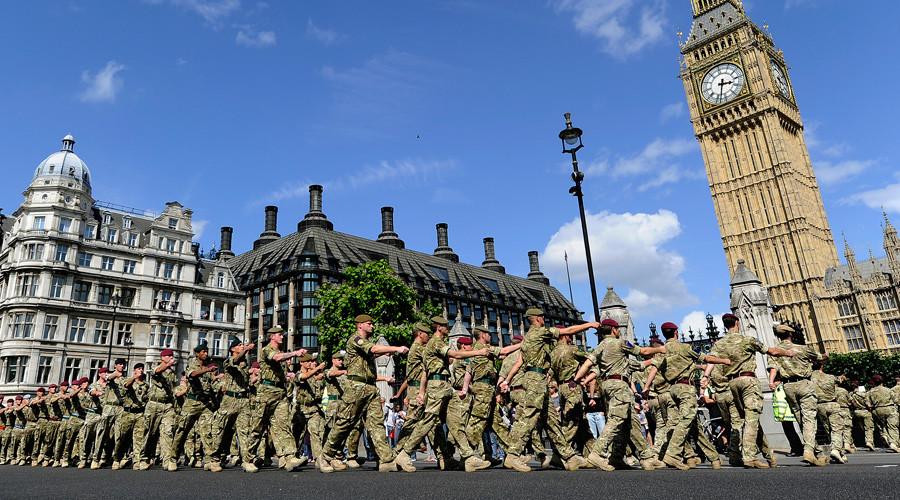
© Paul Hackett A British general has warned that newly-elected Labour leader Jeremy Corbyn could face “a direct challenge” from the army if he becomes prime minister, it was reported in the Sunday Times in London on September 20, 2015.  The unidentified general said Corbyn, who opposes Britain’s Trident program and supports withdrawal from NATO, would face “direct action” if he tries to downgrade the army.  The general added that a Labour victory under Mr Corbyn in 2020 would result in “mass resignations at all levels” and there would be the “very real prospect of an event which would effectively be a mutiny”. While Labour publicly refused to comment on the views of what it described as an “anonymous general”, in private senior sources described the remarks as “pretty outrageous”.  “You can’t have serving officers effectively threatening a coup against an elected government,” they said. “This general seems to have forgotten that we live in a democracy.” A Ministry of Defense source said it was unacceptable for a serving officer to make political comments about a potential “future government.”

Even some Conservatives expressed disquiet. The right-wing Tory Member of the European Parliament, (who by the way,  happens to have been born in Peru) Daniel Hannan, described the general as an “idiot” memorably stated: “We’re not Bolivia, for God’s sake.”

Le courage de ses convictions

Il n’est pas toujours facile d’avoir le courage de ses convictions, surtout dans le domaine de la justice militaire. Le Service canadien des avocats de la défense conteste par voie de requêtes devant une cour martiale permanente la constitutionnalité des articles 60(2) et 69(1) de la Loi sur la défense nationale (Loi) dans le dossier Wade Pear and Her Majesty The Queen et les articles 101.1 et 158.6 de cette même Loi dans le dossier 2Lt Caicedo, C.W. and Her Majesty The Queen. Les deux requêtes sont rédigées en anglais.

Les articles 60(2) et 69(1) permettent à la justice militaire de poursuivre un civil pour une infraction militaire qu’il a commise alors qu’il était membre de la force militaire. Dans le cas présent il y a plus de deux ans que M. Pear a quitté les Forces armées canadiennes et les infractions ont été commises il y a près de trois ans. Il ne s’agit que d’un seul événement survenu lors d’un diner régimentaire. L’accusé se serait retrouvé en état d’ébriété, aurait tenu un langage offensant à l’égard de deux officiers supérieurs.  Son comportement lui a valu trois chefs d’accusations mineures.

Les arguments des procureurs de M. Pear sont intéressants. Ils se  réfèrent à la décision de la Cour Suprême du Canada dans l’arrêt R. c. Généreux (1992) 1 RCS 259, dans lequel la Cour justifie l’existence du système parallèle de justice militaire canadien pour des questions se rapportant directement à la discipline, à l’efficacité et au moral de la force militaire et par la nécessité de sanctionner rapidement les manquements à la discipline. Ils soutiennent que, dans le cas présent, non seulement les infractions en cause sont mineures, mais que la poursuite d’un civil devant un tribunal militaire 4 ans après le manquement disciplinaire n’a plus de lien direct avec la discipline militaire et plus d’impact direct sur la discipline ou l’efficacité opérationnelle de son unité ou d’autres unités.

En conséquence, les articles 60(2) et 69(1) ont une portée trop large, excessive, qui viole le droit constitutionnel à la liberté et à la sécurité de la personne garanti par l’article 7 de la Charte canadienne des droits et libertés (Charte).

Dans le deuxième dossier, l’accusé fait face sous l’article 101.1 à 4 accusations d’avoir fait défaut de respecter les conditions de remise en liberté imposées par son Officier Commandant. Encore là la contestation prend sa source dans l’article 7 de la Charte qui stipule qu’une personne ne peut être privée de sa liberté qu’en conformité avec les principes de justice fondamentale qui requièrent une audition devant un juge indépendant et impartial. Or l’article 158.6 prévoit une révision des conditions de remise en liberté par le supérieur de l’Officier Commandant, donc par la chaîne de commandement qui n’offre pas les garanties constitutionnelles d’indépendance et d’impartialité.


L’article 31 du projet de loi C-15 voté, mais non encore en vigueur, prévoit que les conditions de remise en liberté imposées par la chaîne de commandement pourront être révisées par un juge militaire. Pour l’instant l’accusé dans ce dossier qui ne bénéficie pas de cette disposition législative demande une déclaration d’inconstitutionnalité de l’article 158.6 et le rejet des 4 chefs d’accusation portés contre lui. À suivre....

Saturday, October 10, 2015

Who is a civilian?

Phil Cave beat me to the punch about the story about how Somali authorities have rejected criticisms that they are using military courts to try civilians.

What distinguishes Somali practice from the use of military commissions under the U.S.'s Military Commissions Act of 2009, Egypt's use of military courts, Pakistan's 21st Amendment courts, etc.? Are there neutral principles that permit us credibly to distinguish between legitimate and illegitimate uses of military courts to try persons who are neither members of the trying state's armed forces nor combatants recognized under the Third Geneva Convention?

Somalia in the new still

Over the 18 months we've posted about various military law issues in Somalia.  Today we have a report that:

A Somali military official has dismissed allegations by the European Union that the government uses its military tribunal to prosecutes civilians.
According to a statement from the European Union, at least 29 people have been executed so far this year across Somalia by state authorities.
‘’The majority of these executions took place through the military court system. We strongly urge the Somali authorities to avoid the use of military courts in civilian cases and to ensure that due process is fully adhered to, including that proper systems of appeal are in place.’’
Courtesy of Horseed Media.

You may wonder the EU interest in Somalia;[more here]. And the EU's top military General visits Somalia, sends message to armed forces.